


Most runners think improvement comes from hard workouts.
I thought so too for many years. In high school we pounded 3 hard interval workouts a week and I still didn’t think I was training hard enough. Then for a time in university I had an old school coach who had us do interval training Monday through Thursday and sometimes Friday as well. We spent the weekends lying around trying to recover.
Long story short, I set 2 personal bests in the very first meet, then got injured and missed the rest of the season.
It wasn’t until much later that I realized that the gains from intense workouts were fleeting and came with a huge cost in terms of energy, injury risk and consistency of training.
For all runners, but especially for those over 40, the greatest long-term gains come from something much simpler:
Easy running.
Or as coach and runner Steve Boyd once eloquently put it in his PhysiKult Running blog, “The ability to get your ass out the door for a run every day.”
While there is definitely a place for intense work, easy runs are the substance behind the style. They are the backbone of every distance runner’s training plan and the area that leads to the greatest long-term improvement with the lowest (assuming they’re done right) injury risk.
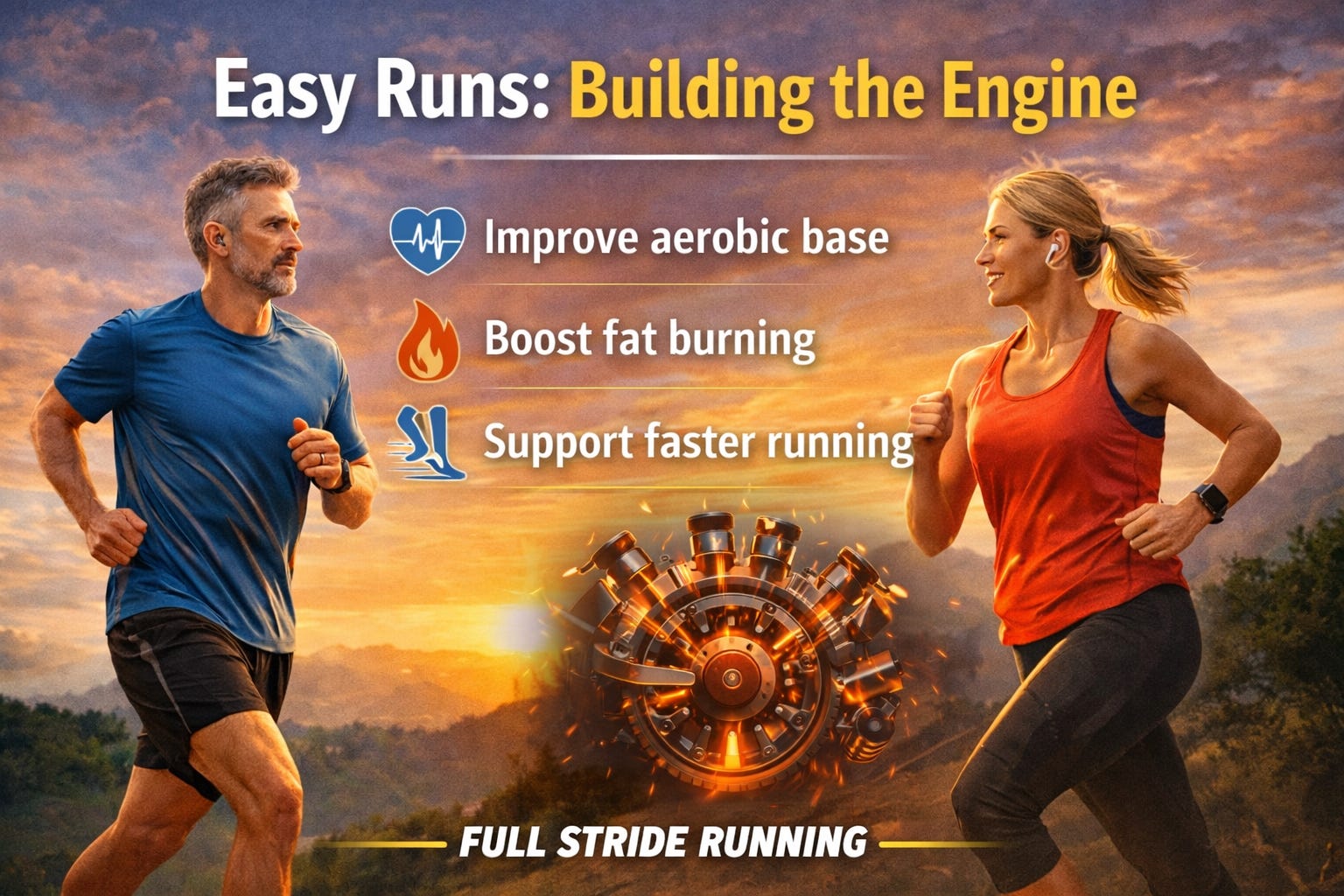
Building the Engine
Easy running builds the aerobic engine through:
Mitochondrial Development. Easy running increases number and efficiency of mitochondria which allows you to produce more energy, so you can run faster for longer.
Capillarization. Easy running builds more capillaries, the small blood vessels that deliver oxygen to your muscles. More capillaries means more blood gets to your muscles, which mens more oxygen, which means improved endurance and recovery.
Fat Utilization. Easy running helps teach your muscles to burn fat more efficiency, which helps you save muscle glycogen for faster efforts. This allows you to run farther and faster without bonking.
Structural Adaptation. Easy runs strengthen your tendons, ligaments and bones to help you build durability over time, reducing your injury risk.
Even Greater Benefits for Masters Runners
Easy running works especially well for runner over 40.
Less stress on your muscles and joints means lower injury risk. There is also lower stress on the nervous system so you can sustain it over time without overtraining.
Doing mostly easy running allows you to be more consistent in your training week after week. Those “Where’s the nearest garbage can?” type of interval sessions are very difficult to do on a regular basis.
More easy running also supports better recovery from harder sessions. The more easy mileage you can do without overdoing it, the faster you recover, not only in between workouts but also during workouts.
For example, a runner doing 25 miles a week doing 10 reps of 400m at mile pace might need 2-3 minutes of recovery between reps to maintain the correct pace. A runner doing 50 miles a week might only need 90 seconds between reps at the same effort level. The increased endurance from greater easy mileage allows for a higher density of training (ie. more harder efforts, closer together).
Who do you think has a better chance of maintaining the desired pace on race day?
The Hidden Benefit: Enjoyment
It’s also important to note that easy runs are an enjoyable way to train because they:
Feel relaxed
Allow conversation
Reduce pressure
Make running sustainable long-term
More enjoyment leads to greater consistency of training and hey, it’s just more fun.
How to Run Easy:
Keep the effort conversational. You should be able to easily chat with your running partners throughout the run. If you like to measure heart rate on your runs keep it to ~70–75% max. Any faster and it will start to feel like work. Running faster does not give more benefit and may delay your recovery. You should finish your run feeling like you could go much longer.
Let the pace come to you. Some runners feel they should run a certain pace for their easy runs, but easy isn’t a pace, it’s a feeling. Some days you’ll be feeling good, and the pace might be a little quicker despite being truly easy. Other days, you’ll be tired and may have to slow down as much as a minute or more per mile compared to your usual pace. This is perfectly ok.
The main benefits from easy runs come more from time on your feet than from pace. Better to run longer and slower than shorter and faster.
Easy runs build your aerobic engine, protect you from injury and allow you to run longer, faster with less stress. If you want to run faster, run easier more often.
What’s the biggest challenge in keeping your easy runs truly easy?
Let me know in the comments.
Cheers,
Dan.