

One of the biggest mistakes runners make is assuming that more training automatically leads to better results.
Sometimes it does, but often it doesn’t.
More training is the stimulus, and more stimulus helps if you can recover from it and rebuild stronger. On the other hand, if the stimulus is so strong that it overwhelms your body’s ability to adapt, or if you have repeated stimulus before you’ve adapted to previous training, it will break you down and cause injury, illness, or impare your ability to respond in the future.
I recommend a different approach.
Rather than chasing the maximum amount of training possible, we focus on finding your training sweet spot.
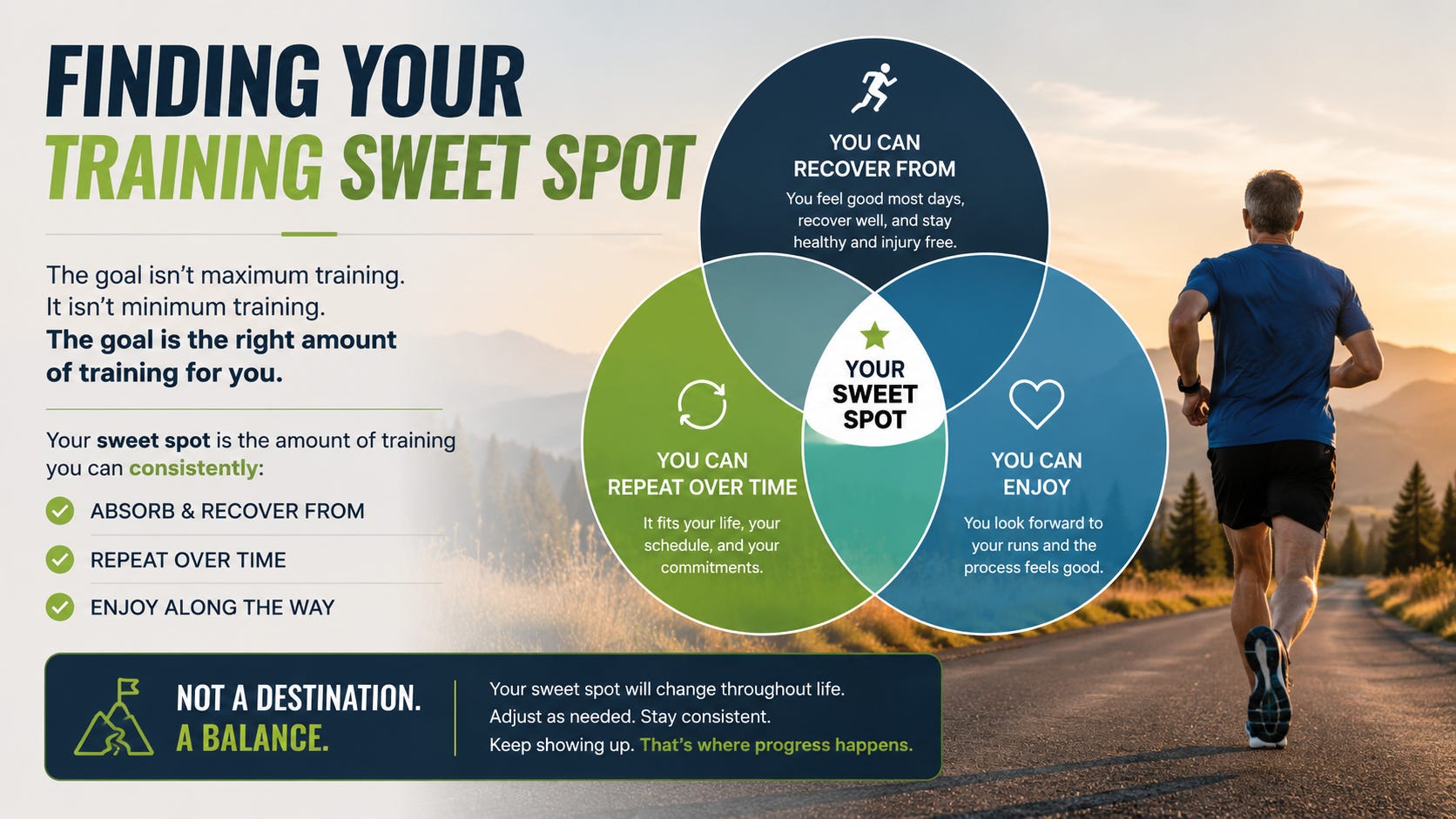
Your sweet spot is the amount of training you can consistently absorb, recover from, and enjoy while continuing to improve. It’s where your overall training load feels challenging but doable.
It is where you can make progress while avoiding injury and burnout.
The Problem With “More”
Many runners spend years searching for the perfect mileage number.
If 40 kilometres per week is good, maybe 60 would be better. If 80 is good, maybe 100 would be even better.
Sometimes those increases work, but more often they lead to fatigue, injury, burnout, or inconsistency.
The reality is that every runner has a point where additional training produces diminishing returns. The challenge is finding where that point exists for you.
The 3 Questions
When evaluating your training, ask yourself three questions:
1. Am I Recovering Properly?
Recovery is the foundation of adaptation.
If you are constantly tired, sore, or struggling to complete workouts, your training load may be too high.
2. Is This Repeatable?
A great week means very little if it leaves you unable to train effectively the following week.
The goal is not a single impressive training block, it’s sustainable progress over time.
3. Am I Enjoying It?
This question is often ignored. It shouldn’t be.
Remember one of the core beliefs of The Full Stride Method:
Train in a way that allows you to enjoy the process.
If training constantly feels like a burden, it’s impossible to maintain over the long term.
And hey, if you’re not enjoying it, why do it?
The Sweet Spot Changes
Another important reality is that your sweet spot is not fixed. It changes throughout life. What works for you at 30 years old will not work when you’re 60.
Factors that influence your sweet spot for training include:
Age
Fitness level
Work demands
Family commitments
Sleep
Stress
Health
There may be periods when you can handle more training. There may be periods when less is appropriate. Both are normal. It’s about constantly listening to your body, learning and finding a way to adapt.
Successful runners learn to adjust rather than force a rigid plan.
More Isn’t Always Better
One lesson I learned over many years of running is that the highest mileage I could survive was not necessarily the mileage that produced my best results.
There is a difference between:
Maximum training
Optimal training
As exercise scientist Stephen Seiler rightly points out, “Training is an optimization challenge, not a maximization challenge.”
The more training you do, the more risk you take on in terms of injury, illness and overtraining. Ideally, you want to do the least training possible to achieve a desired training effect. You want the best bang for your buck.
The goal is not to discover how much training you can tolerate. It’s to discover how much training helps you thrive.
Those are not necessarily the same thing.
Signs You’ve Found Your Sweet Spot
You are probably close to your sweet spot when:
You look forward to most runs
Recovery is manageable
Injuries are rare
Training feels challenging but sustainable
Performance is gradually improving
Running fits comfortably within your life
Notice that none of these measures require perfect workouts or perfect race results.
Instead, they reflect a healthy and sustainable training process.
Thinking Long Term
Many runners ask:
“How much can I run?”
A better question is:
“How much can I run consistently for months and years?”
An even better question is:
“How much can I run consistently while still enjoying the process?”
Those questions lead to a very different approach to training.
And in my 46 years of experience as a runner, they lead to better results.
Key Takeaway
The goal is not maximum training.
The goal is optimal training.
Your training sweet spot is the amount of running you can consistently absorb, recover from, and enjoy while continuing to improve.
Find that balance. Refine it over time.
Because the runners who stay healthy, motivated, and consistent are often the runners who improve the most over the long term.
Thanks Claire. Yeah, it can be tough if you travel a lot. I used to travel for work periodically and my running definitely suffered at times. The good news is that every little bit helps, so even if you can get 15 or 20 minutes of running in at a time, there’s still a positive effect.
All the best,
Dan
Great article , my challenge with running is that I travel a lot. I can get into a routine if I am one month in one place - otherwise really tricky.