

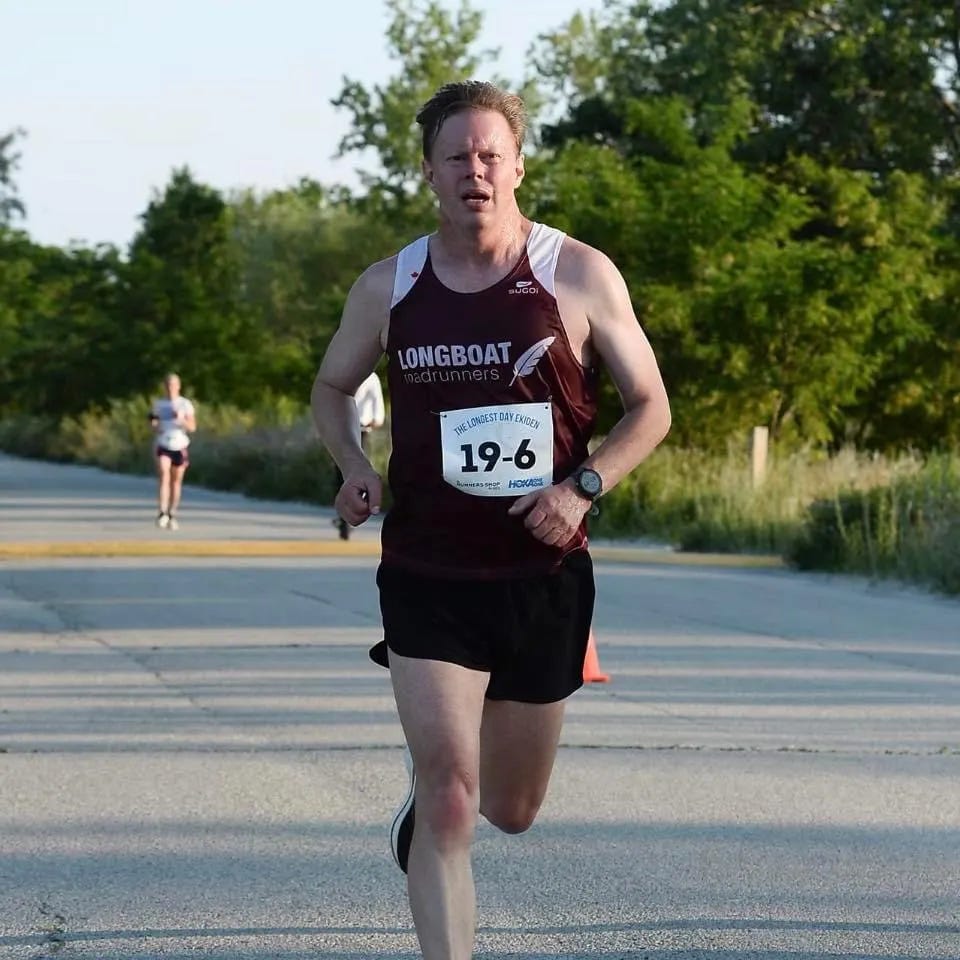
(This is a repost of an article I wrote on Medium in 2024. I still use the same simple formula and am now using it to build for the Toronto Waterfront Marathon in October of 2026)
Running competitively as a masters runner (age 40+) can be a real challenge. It’s a constant juggling match trying to balance training in a way that produces meaningful results without getting injured or overly fatigued. You want to do enough to remain competitive without beating yourself up and either getting injured or sacrificing the consistency of training required to produce your best possible racing fitness.
Despite my over 40 years of experience in the sport, I still find it a struggle sometimes. My solution is to simplify it as much as possible. My simple strategy has allowed me to put together a few years in a row of consistent improvements since turning 50 back in 2018. I’ve improved in absolute terms over the past 5 years despite getting older and my age graded performances have improved from the mid 60% range to the low 70s.
Here’s my basic weekly plan:
1 long run per week
1 speed workout
1 rest day
4 easy aerobic mileage days
Let me break down each of these elements:
Long Run
I aim for one long run each week of between 90 minutes to 2 hours at a relatively comfortable pace. Often this run will start slowly and gradually get faster over the course of the run, finishing with the last 30 minutes or so approaching my half marathon pace + about 20-30 seconds per km. Not fast, not straining, but enough to make me feel like I’m getting a solid run in. Usually my long run will fall on a Sunday, but that may vary depending on other life commitments.
Speed Work
This is the area of my training that varies the most. I aim for between 2 to 5 miles or so of speed work and I aim to run race pace or a little faster for the distance for which I’m training.
For example, when I’m training for indoor track season, my primary event is the 1500m or mile. During this time, a typical workout would be:
20 minute jog to warm up + 4 or 5 accelerations of 50–80m
8–10x400m with a 2 minute rest
10 minute jog to cool down
If I’m training for a half marathon, my speed work day would be more like:
20 minute warm up
3x10 min @ about 10km race pace, with a 5 minute jog between reps
10–20 minute jog to cool down
The point of these workouts is to become more comfortable running at race pace. I don’t worry too much about physiological parameters such as VO2 max or lactate threshold. Regardless of those constructs, if I’m training at race pace, I know I’m developing the physiology to support running at that pace.
Easy Aerobic Runs
These are just the easy, putting in the miles type of runs that support your overall endurance and build your aerobic capacity. Your basic “Zone 2” training if you will. I don’t worry about heart rate or lactate or anything on these runs, I just run easy enough to feel recovered for my long runs and speed work.
Rest Day
I find I need a rest day the day after a long run. If I try to run the day after a long run, I can get through it ok, but then often find myself dragging for a few days after. Taking a complete rest day helps recharge physically and mentally thus helping me stay healthy and consistent in my training.
I have tried occasionally adding a second speed workout, but have never managed to keep it going for very many weeks in a row without undue fatigue setting in. Also, I don’t seem to find much benefit from lots of speedwork. Generally a good mileage base and 4–6 speed sessions gets me pretty close to a peak.
The simple easy formula of 1 long run, 1 speed work day and the rest easy running has helped me stay injury free and continue to improve into my 50s.