


A lot of runners ask:
“Which is more important, mileage or speedwork?”
It’s the wrong question.
For most runners, especially runners over 40, the fastest times don’t come from choosing quantity or quality.
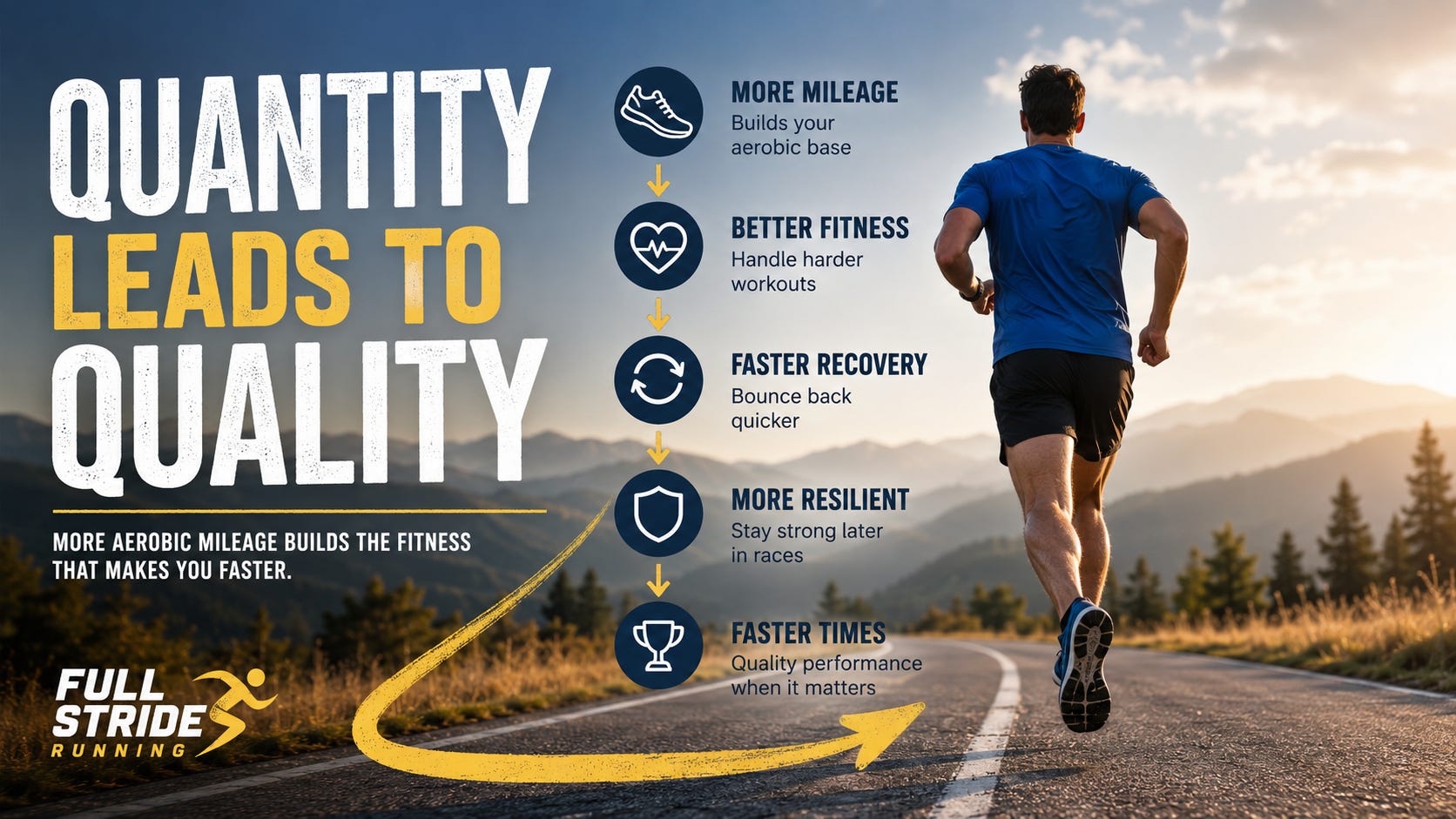
They come from understanding that quantity creates quality.
The aerobic fitness you build through consistent mileage is what allows you to handle harder workouts, recover faster, and stay strong when races get difficult.
Why Most Runners Get This Backwards
Many runners fall in love with workouts. I certainly did back in the day.
I used to think that more intervals, more tempos, harder workouts were the sessions that led to faster running.
Those sessions are exciting because they feel productive.
Easy mileage often feels too simple to matter.
The result?
A runner doing low mileage but trying to cram in two or three hard workouts each week because they think the workouts are the thing that’s creating fitness.
It’s a recipe for burnout, self doubt and bad races.
The fact is, you need a strong aerobic foundation in order to handle the faster sessions, recover properly, and actually benefit from them.
Without that foundation:
Recovery takes longer
Workouts become inconsistent
Injury risk increases
Race performances become unpredictable
I was a classic example of this in high school and university. I put everything I had into the 3 intervals sessions we did each week. Weekly mileage was an afterthought.
The result was like trying to build a house without a foundation.
I would run some good times early in the season, but inevitably fall short as the season progressed. Partly because of a lack of aerobic fitness, and partly because I was putting so much into the workouts that I had nothing left for the races.
As the season went on I’d often find myself getting to the hard part of the race and instead of being challenged and excited to see what I could do, all I could think was, “Oh god, not this again …”
I could usually manage a decent 800m, but anything longer saw me drifting further and further back from where I thought I should have been. My 1500m races were significantly slower than they should’ve been and 3000m on the track or 5km cross country? Forget it.
The Real Purpose of Mileage
In the years since, I’ve learned that aerobic mileage does far more than just look impressive in your logbook.
Consistent aerobic running:
Increases capillary density
Improves mitochondrial function
Builds fatigue resistance
Strengthens connective tissues
Improves fuel utilization
Expands your aerobic capacity
All of those adaptations not only build your endurance, they make quality training more effective.
The runner with a larger aerobic base can simply absorb more training.
How Quantity Creates Better Quality
1. You Recover Faster
A stronger aerobic system clears fatigue more efficiently.
That means you can complete a quality workout on Tuesday and feel reasonably good by Thursday.
The less aerobically developed runner may still be recovering when the next workout arrives.
2. You Can Handle More Work
Consider two runners.
Both run 6 × 800m.
One runner trains 70 km per week.
The other trains 30 km per week.
Who is more likely to:
Finish the workout strongly?
Recover quickly?
Repeat the session next week?
Almost always the higher-mileage runner.
Not because they’re tougher.
Because they have a bigger aerobic engine and therefore they recover more quickly between intervals and can hold a given effort level for longer.
3. You Become More Durable
One of the biggest benefits of mileage is durability.
Higher mileage runners tend to become more resilient to:
Long races
Consecutive hard weeks
Minor setbacks
Late-race fatigue
Durability isn’t glamorous, but it’s often what separates good races from great races. In fact, right now durability and how to build it is one of the hottest topics in running research right now.
4. You Finish Stronger
Many runners can run fast for the first half of a race.
The challenge is maintaining pace after fatigue arrives. A larger aerobic base delays fatigue and preserves efficiency later in the race.
This is how Jakob Ingebrigtsen wins his races. Not because he is faster in a sprint than everyone else, because he can keep going at a pace the others can’t live with.
What This Means for Masters Runners
After 40, recovery becomes more important.
That doesn’t mean quality disappears. In fact, it’s important that you maintain significant quality in your training as you age. But that quality becomes even more dependent on aerobic fitness.
Think of aerobic training as the cake, and intervals as the icing. In the right proportions, it tastes great. Too much of one or the other and you’re going to be left disappointed.
Many masters runners improve by:
Running more consistently
Increasing mileage gradually
Keeping most runs easy
Using moderate workouts instead of all-out sessions
The goal isn’t to eliminate intensity, it’s to create the foundation that allows intensity to work.
Takeaway
The short term studies we see posted often present a false choice.
Quantity vs quality. Zone 2 vs HIIT. Mileage vs speed.
The truth is that quality training has to be built on a foundation of quantity to get the best results.
More aerobic running allows you to train harder, recover better, race stronger, and stay healthy longer.
The challenge becomes, “How much aerobic fitness can I build so quality training becomes most effective?”
Because in running, quantity and quality aren’t opposites.
Quantity leads to quality.