


I joined my first track club at the tender age of 11.
I’d watched the 1976 Olympic 1500m a couple of years prior and decided I wanted to be like that. I was lucky enough to win my first public school race at the age of 10 on 2 weeks’ training and figured I was on my way.
Like most young runners, I thought success came from working harder than everyone else. I didn’t think I really had any talent and so decided I must train more or smarter than everyone else in order to win. Run more, run faster, never miss a workout.
Some of those ideas helped.
Some of them cost me years of progress.
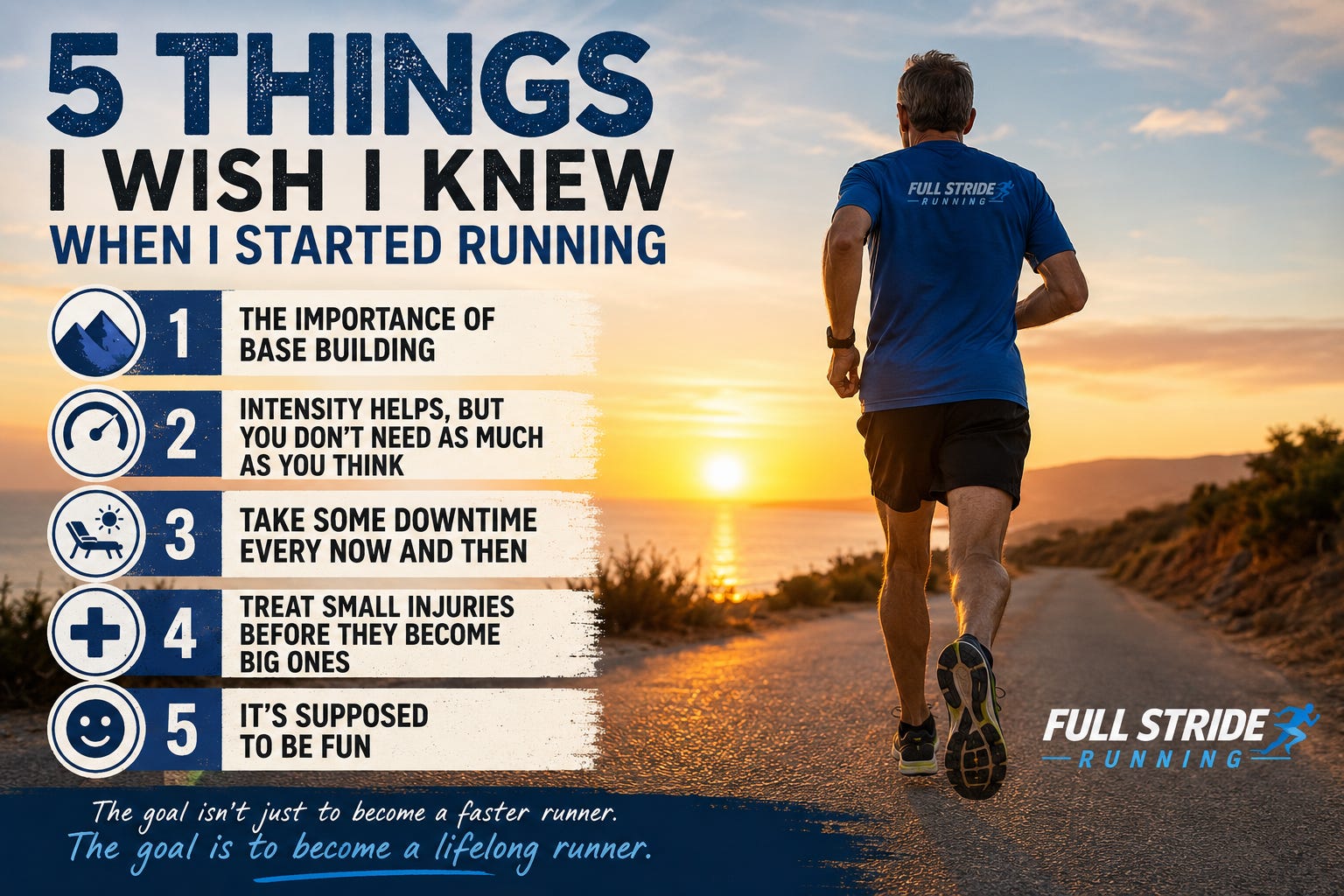
After nearly five decades of running from childhood races to personal bests, burnout, injuries, masters competition, road races and marathons there are a few things I wish someone had told me when I started.
Here are five lessons I learned the hard way.
1. Base Building Matters More Than Almost Everything Else
When you’re young, workouts are exciting.
Intervals, hill sprints, races. I assumed that the hardest workouts were what would produce the greatest fitness.
In the short term, that’s true. In the long term, it’s a recipe for burnout and injury.
Over time, I learned that aerobic fitness is the foundation that supports everything else.
A strong aerobic base allows you to:
Recover faster
Handle harder workouts
Stay healthy
Race stronger late in events
Train consistently year after year
Many runners spend too much time looking for the perfect workout when they would be better served by simply building their mileage gradually and consistently.
The best training plan in the world won’t help if you don’t have the aerobic engine to support it.
Lesson:
Don’t rush the process. Build your base. The easy aerobic miles are the foundation of your fitness, not the hard sessions.
2. Intensity Helps, But You Need Less Than You Think
For years I believed improvement came from harder workouts.
Then I watched talented runners burn out.
I did it myself more than once.
One period of my career included hard interval sessions three times per week. I improved somewhat, but I was constantly tired and eventually lost my enthusiasm for training.
On race day, especially later in the season, I’d get to the hard part of the race and instead of being excited to challenge myself and see what I could do, I’d be thinking, “Oh god, not this again.”
Then I’d beat myself up after the race and resolve to just work harder. Which, I now know, was exactly the wrong approach.
Today, I believe most runners get far better results from a small amount of quality training supported by a large amount of easy running.
A simple formula often works remarkably well:
One faster session
One long run
Everything else easy
Hard workouts are important.
They’re just not as important as consistency.
Lesson:
Use intensity as seasoning, not the main course.
3. Take Some Downtime Every Now and Then
For a long time, I viewed rest as lost fitness.
Now I view it as an investment in future fitness.
The body needs periods of recovery to absorb training and stay motivated. “Micro and macro recovery”, as the running nerds (of which I am one) would call it.
I used to finish one season and be charged up to start training hard for next season right away. Then 3 weeks later the motivation would be flagging or I’d pick up a minor injury, at a time when I should have just been gradually rebuilding my general fitness.
After a racing season or a goal race, you need to recover mentally and physically before you can fully commit to the next build.
It means occasionally:
Taking a few easy weeks at the end of the season. Or even, gasp, a couple of weeks off.
Reducing mileage after a goal race
Taking a short break when mentally fatigued
Allowing yourself to recharge
Many runners get injured or burned out because they never stop pushing.
The goal isn’t to train hard for one season or one race.
The goal is to keep running for decades.
Lesson:
Sometimes the fastest way forward is a brief step back.
4. Treat Small Injuries Before They Become Big Ones
One of the biggest mistakes runners make is hoping an injury will magically disappear.
Sometimes it does, most of the time it doesn’t.
A slight ache becomes a nagging pain. A nagging pain becomes a month off. A month off becomes an entire season lost.
I’ve learned to respect the early warning signs.
When something feels wrong:
Address it immediately. Continuing to run on it (especially if the soreness doesn’t go away in after the first 10-15 minutes of your run) is likely to make it worse.
Reduce training if necessary. A couple of missed days does almost nothing to reduce your fitness, but could be the difference between a down week and a missed goal race.
Strengthen weak areas. A lot of runner hate strength training. I do. But working on your overall body strength helps keep you on the road and out of the doctor’s office.
Get treatment sooner rather than later. A good physiotherapist is worth his or her weight in gold. If you can find one who is also a runner, so much the better.
Most major injuries start as minor ones.
Lesson:
Don’t be tough. Be smart. A bit of caution with minor injuries can save your season.
5. It’s Supposed to Be Fun
This might be the most important lesson of all.
Running is not a job. For 99.9% of us, nobody is paying us to do it.
Yet many runners create unnecessary pressure around every workout and every race result.
I’ve done it too. In fact I was the king of putting too much pressure on myself.
The irony is that some of my best performances happened when I was simply enjoying the process.
Quick story:
I ran a half marathon a couple of years ago that I had trained hard for and was hoping to hit a specific goal. Training went well but my Achilles tendon was very tender at the end of workouts and long runs. To make matters worse, there was a street party outside my hotel room until 3:30am. I might’ve had an hour of sleep, I’m not sure. Then the day dawned at 27C, warmer than I had seen all year.
I considered not running at all, but in the end decided to just run the race to finish at a comfortable pace. “Just make it around the course without needing the paramedics,” I told myself.
So I started slow, high fived the kids along the route, took in the sites. No pressure, no struggle. I was actually enjoying the run, which was quite a revelation and quite different from my usual frantic glances at my watch to stay on pace.
By the 10km mark, I realized I was feeling really good and not too far behind my original goal pace. I picked it up, ran a solid last 10k and ended up within less than a minute of my original goal.
Running relaxed an pressure free gave me a far better race than if I had allowed myself to get stressed out and forced myself to maintain the goal pace early on.
No matter how fast or slow I’ve run over the years, running has given me:
Friendships
Travel
Confidence
Stress relief
Challenges
Memories spanning nearly half a century
The stopwatch matters. But it isn’t the reason most of us started running. And once you’ve passed a certain age, chasing times can take away the joy of running.
Lesson:
Never let your goals steal your joy.
Looking for Personalized Coaching?
If you’re a runner over 40 who wants to train smarter, stay healthy, and enjoy running for life, I’d be happy to help.
I offer one-on-one coaching calls focused on practical, sustainable training that fits around real life. Whether you’re preparing for a race, returning from injury, building consistency, or simply looking for guidance on your running journey, we can create a plan that works for you.
Send me a DM if you’d like more information about coaching or to discuss your goals.
I’d love to hear about your running journey.


