


One of the most common mistakes I see runners make is treating every interval workout like a race.
The thinking usually goes something like this:
“If 5 x 1000 metres at 5K pace is good, then 5 x 1000 metres faster than 5K pace must be even better.”
That’s not how training works.
In fact, running intervals too fast often produces exactly the opposite result of what you’re trying to achieve. You finish the workout feeling exhausted and accomplished, but you may have missed the intended training effect entirely.
The purpose of interval training isn’t to see how much suffering you can tolerate. It’s to create specific physiological adaptations that make you a better runner.
The Goal Is Optimum Pace, not Maximum Effort
Many runners approach interval workouts as a test of fitness. They reason that running a workout at a given pace equates to an equivalent race performance. As a result, they race their training sessions and end up over training or overreaching and leave themselves vulnerable to injury, burnout or poor performance.
Most traditional interval workouts are designed to improve aerobic power, often referred to as VO2 max. To accomplish that, you need to spend time running at an intensity that stresses the aerobic system without pushing so hard that the workout becomes a test of survival.
I was a perfect example of what not to do when I was in my high school and university days. I ran every interval session as hard as I possibly could. I would sometimes run so hard I would get sick or get brutal headaches afterward.
It wasn’t much fun, and it didn’t get me the results I’d hoped for.
I would run great races early in the season, but by the time the championship races rolled around later on in the summer, I’d be too exhausted mentally and physically to give my best. I’d get to the point where the race started to hurt and instead of seeing it as a challenge to see how well I could perform, the only thing going through my mind would be “Oh god, not this again ...” and I’d mentally check out, often running much slower than my capability. I left my best races on the training track.
You don’t want to be like that.
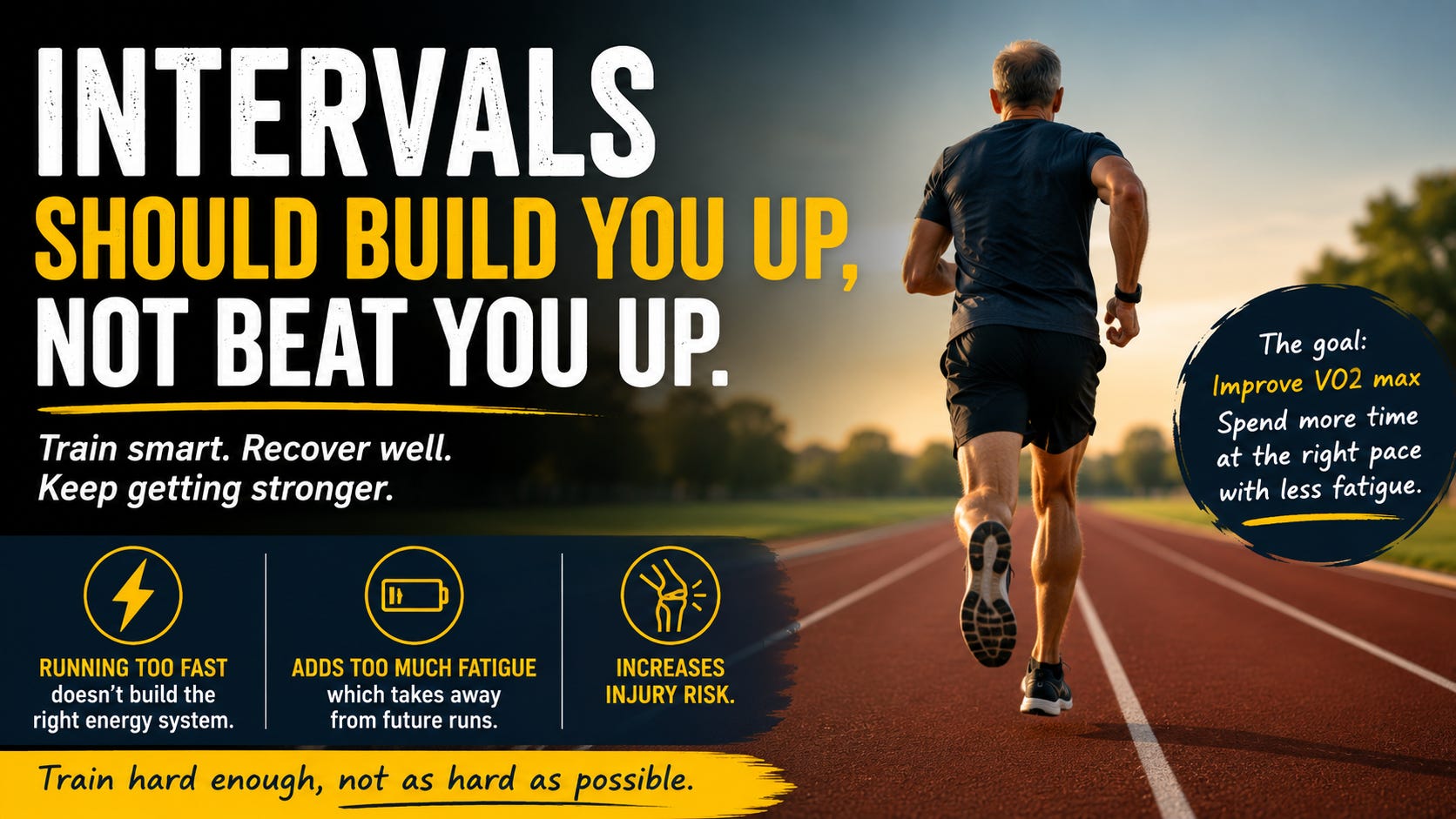
Here are a couple of reasons why running your interval workouts as fast as you can is a bad idea:
1. You’re no longer targeting the intended energy system.
Instead of spending time working near VO2 max, you begin relying more heavily on anaerobic metabolism. The workout becomes more about tolerating acidosis and accumulating fatigue than developing aerobic power.
2. Excessive speed creates excessive fatigue.
You might still complete the workout, but the cost is often much higher than necessary. You arrive at future workouts carrying fatigue that doesn’t need to be there. That fatigue takes away from your ability to properly execute the next days’ run and maybe more after that.
A workout should feel challenging but doable, not leave you depleted for the rest of the week.
3. Running too fast increases injury risk.
The faster you run, the greater the mechanical stress on muscles, tendons, and connective tissues, and unnecessary speed carries unnecessary risk.
If your goal pace is 4:30 per kilometre and you’re repeatedly running 4:00 pace, you’re exposing your body to significantly more stress without necessarily gaining additional fitness. This excessive stress makes you more vulnerable to injury or overtraining.
The Goal is Time at the Target Pace
One of the most useful concepts I’ve learned over the years is that interval training is really about accumulating quality time at the target intensity.
The goal isn’t to run the fastest repetition, it’s to maximize the amount of productive work you can perform.
Let’s say two runners complete the same workout.
The first runner blasts through the first few repetitions, fades badly, and spends the final few intervals hanging on for dear life.
The second runner runs every repetition at the intended pace, remains controlled throughout, and finishes feeling like one more repetition would have been possible.
Who had the better workout?
The second runner accumulated more effective training time, experienced less fatigue, and will get the better adaptation while recovering faster for future sessions.
Leave One Rep in the Tank
One of my favourite training principles is simple: Finish the workout feeling like you could have done one more repetition.
This idea keeps you from trashing yourself, leaves you feeling confident and in control of the session, allows you to recover more quickly and reduces your injury risk.
Final Thought
When designed and executed properly, interval workouts improve aerobic power, develop running economy, and help you become a stronger runner. They should challenge you, but they shouldn’t destroy you.
Train hard enough, not as hard as possible.


Thanks for this Dan