

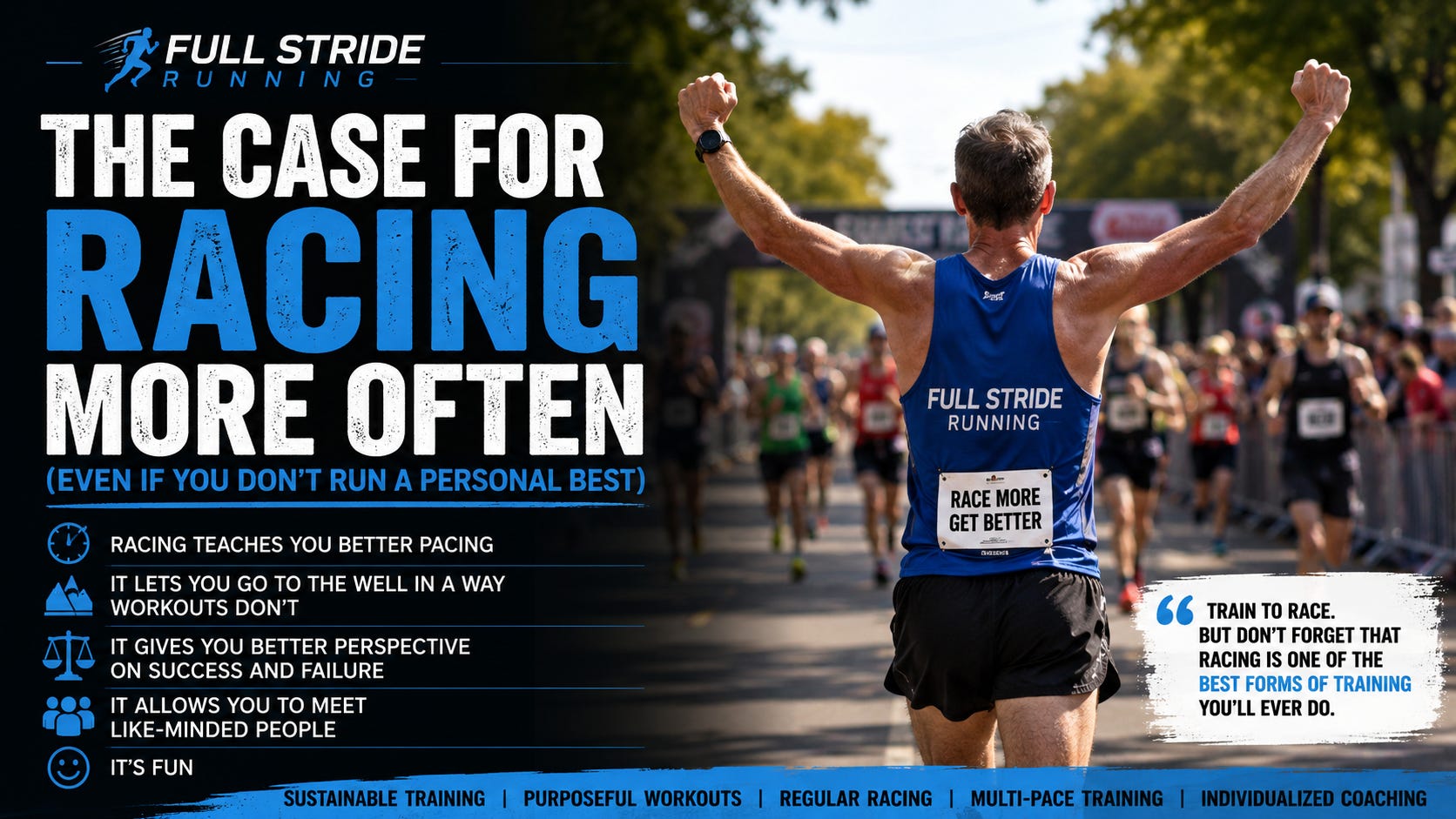
Many runners spend months training for only one or two races each year.
They treat races like final exams, a months long suffer fest of a training program that builds toward a single day.
I think that’s a mistake.
Some of the best runners I’ve known raced regularly. They didn’t expect a personal best every time. They raced because racing itself made them better runners.
Here are some of the reasons I’d argue that runners should race frequently.
Racing Is a Skill
Running fitness and racing well aren’t exactly the same thing.
Racing is a specific skill that, like any other skill, requires practice to master. It’s difficult to replicate race effort in training, and in most cases I don’t think you should.
Training is for building fitness, racing is for expressing that fitness.
The more you race, the more you learn:
How hard you can really push.
What different paces actually feel like, especially as fatigue sets in.
When to stay patient.
When to start competing.
No workout perfectly recreates the pressure and excitement of race day.
Like any skill, racing improves through repetition.
You Learn to Pace Yourself
One of the biggest mistakes runners make is going out too fast.
Regular racing teaches you:
what sustainable effort feels like
how to resist the adrenaline of the first kilometre
how to respond when someone you’re competing with throws in a surge (or how to throw one in yourself).
how to finish strongly instead of simply hanging on
Every race becomes another lesson in pacing.
Racing Takes You Somewhere Workouts Can’t
Even your hardest interval session comes with built-in recovery.
A race doesn’t.
There comes a point where your body is asking you to slow down, but your mind decides whether you will. That willingness to stay uncomfortable is difficult to develop in training alone.
Racing teaches you where your real limits are and often they’re farther away than you imagined.
Success Isn’t Always a Personal Best
When you race frequently, you stop judging every performance as either success or failure based on your time alone. Not every race will be a personal best, and that’s ok.
Instead, success can mean:
executing your pacing plan
racing smarter than last time
beating someone you’ve never beaten
handling difficult weather
discovering a weakness to improve
Every race provides valuable feedback that you can take forward with you.
Racing Builds Community
One of the overlooked benefits of racing is the people you meet.
If you spend enough time at local races, you’ll start to see familiar faces. You’ll make friends. You’ll encourage beginners and be inspired by athletes twenty years older who are still competing.
The running community becomes much richer when you’re part of it instead of just training alone.
Racing Should Be Fun
Somewhere along the way, many runners forget why they started.
Races have:
nervous excitement
road trips
coffee (or another beverage of choice) afterwards
conversations at the starting line
stories you’ll remember years later
Not every race has to be about chasing a qualifying standard.
Sometimes it’s enough to simply enjoy testing yourself. You work hard, you get a result, and you have a great time doing it.
My Philosophy
One reason I believe in regular racing is that races aren’t interruptions to training.
They are training.
A local 5K, parkrun, cross-country race, trail race or mile can often replace a hard workout while teaching lessons that no workout ever could.
For many runners, racing every three to six weeks keeps motivation high, sharpens fitness and reminds us why we love this sport.
Run enough races that the finish line feels familiar.
Some will go brilliantly, some won’t. But you’ll almost always come away with memories you’ll treasure.
Because in the end, racing isn’t just how we measure fitness.
It’s where we learn how to become better athletes.


