

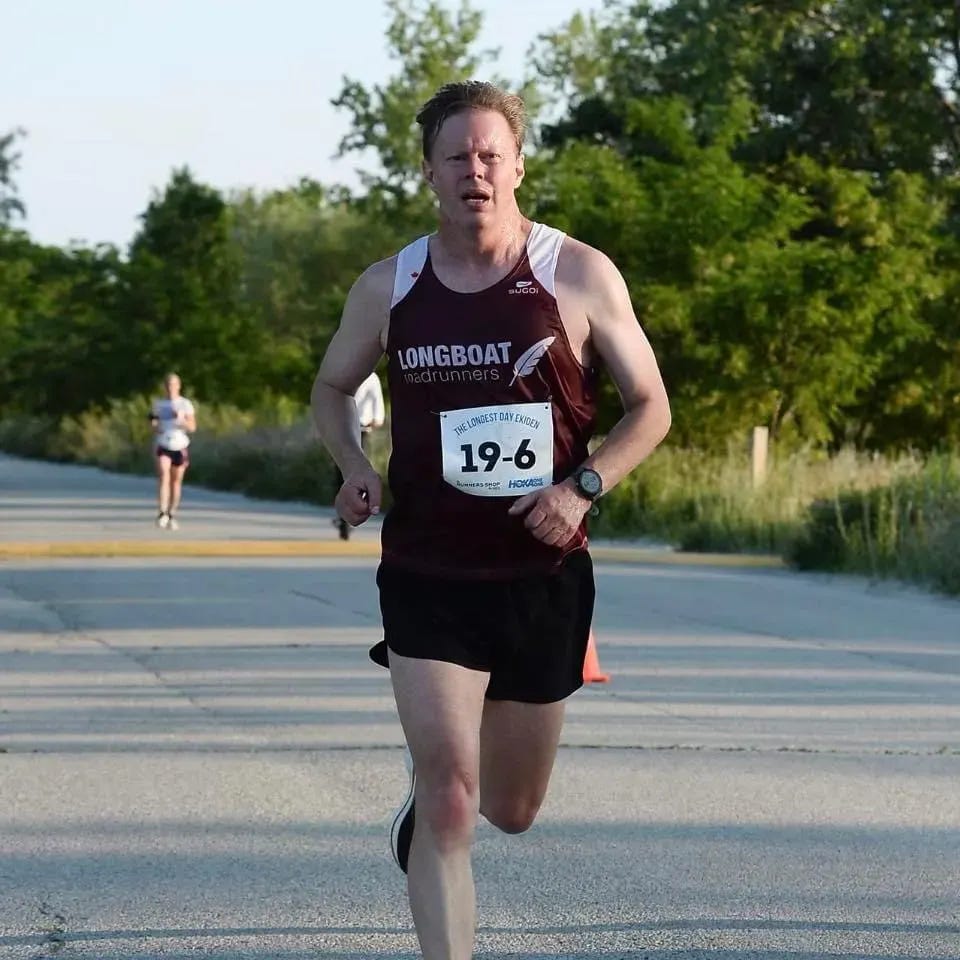
You still want to get faster. You just don’t want running to take over your life.
If you’re an experienced runner in your 40s, 50s, 60s or beyond, you probably don’t need someone telling you to work harder.
You need to know how hard to train, how much to run, when to recover and how to put it all together.
That’s what I help runners do.
I provide personalized one-on-one coaching for runners who still have goals — whether that’s a faster 5K, a Boston qualifier, a marathon PB or simply finding out how fast you can still run.
The goal isn’t to train as hard as possible.
It’s to train hard enough to improve while staying healthy, consistent and enjoying your running.
Interested in coaching? Send me a message and tell me about your running and your goals.
Does This Sound Familiar?
You’ve been running for years, but what worked when you were younger doesn’t seem to work quite as well anymore.
Maybe you’re:
Training consistently but your race times have stopped improving
Getting injured every time you increase your mileage or intensity
Running your easy days too hard and your hard days exhausted
Following generic training plans that don’t fit your life
Unsure how much speedwork you actually need
Struggling to balance running with work, family and recovery
Still ambitious — but increasingly aware that you can’t recover like you’re 25 anymore
You don’t necessarily need to train more.
You need to make the training you’re already doing work better.
My Approach: The Full Stride Method
I’ve spent more than four decades running, racing, experimenting and learning what works and what doesn’t.
My coaching is built around a few simple principles.
Sustainable Training
Training only works when you can recover from it.
We’ll find the amount of mileage and intensity that challenges you enough to improve without constantly pushing you toward injury, exhaustion or burnout.
Every Workout Has a Purpose
You should understand why you’re doing each workout.
Easy runs develop your aerobic system and help you recover. Tempo and interval sessions develop specific aspects of fitness. Long runs build endurance. Strides and faster running help maintain speed and running economy.
Multi-Pace Training
Distance runners shouldn’t spend the entire year running at only one or two speeds.
Depending on your goals and training phase, we’ll use an appropriate mixture of easy running, strides, hills, tempo running, intervals, race-specific training and racing itself.
Regular Racing
I believe racing is a skill.
Racing different distances throughout the year can help develop fitness, maintain speed, provide motivation and teach you how to compete.
Not every race has to be a goal race.
Individualized Training
You’re not a spreadsheet.
Your age, running history, current fitness, injury history, work schedule, family commitments, goals and ability to recover all matter.
Your training should reflect you.
What Coaching Looks Like
You won’t receive a generic 12-week training plan and be left on your own.
We’ll start by looking at where you are now:
Your recent training.
Your running history.
Your race performances.
Your strengths and weaknesses.
Your schedule.
And most importantly, where you want to go.
From there, I’ll build your training around you.
As the training progresses, we’ll adjust it based on how you’re responding.
Because the best training plan isn’t the one we write on Day 1.
It’s the one that evolves as you do.
What You’ll Get
As a one-on-one Full Stride athlete, you’ll receive:
A personalized training plan built around your goals and schedule
Regular adjustments as your fitness develops
Appropriate training paces and workout guidance
Feedback on workouts and races
Help planning your racing schedule
Guidance on mileage, long runs, workouts and recovery
Accountability without unnecessary pressure
Direct access to me for questions and training discussions
The objective is to take the guesswork out of your running.
You’ll know what you’re doing, why you’re doing it and how it fits into the bigger picture.
Who I Coach
I work primarily with adult and masters runners who are serious about improving but want running to remain a positive part of their lives.
You don’t need to be fast.
But you should have goals.
Maybe you want to:
Break 25 minutes for 5K.
Run your fastest 10K in years.
Qualify for Boston.
Set a new age-group PB.
Return to racing after years away.
Or simply see what you’re capable of in the next chapter of your running life.
If you’re willing to train consistently, communicate honestly and take a long-term approach to improvement, we’ll probably work well together.
Why Work With Me?
I’ve been a runner for more than four decades.
I started running as a kid, competed seriously through my teens and university years, and continued racing as an adult and masters runner.
Along the way I’ve run:
1:57 for 800m
4:10 for 1500m
16:35 for 5K
35:27 for 10K
1:21 for the half marathon
3:00 for the marathon
I’ve also run the Boston Marathon three times.
But my coaching isn’t based simply on what worked for me when I was young.
In many ways, the more valuable lessons have come from the decades since.
I’ve experienced good training, bad training, breakthroughs, plateaus, injuries, comebacks and the changing realities of training as we get older.
After more than four decades in the sport, I still believe runners can improve well into their masters years.
We just need to train intelligently enough to give ourselves the opportunity.
What I Won’t Ask You to Do
I won’t give you hard workouts simply to make the training look impressive.
I won’t have you racing your easy runs.
I won’t automatically prescribe two or three hard workouts every week because that’s what an elite runner does.
And I won’t expect running to take priority over everything else in your life.
Sometimes the smartest thing we can do is push.
Sometimes it’s back off.
Good coaching is knowing the difference.
Ready to See What You Can Do?
If you’re still excited about running and still curious about what you might be capable of, I’d love to hear about it.
Send me a message and let’s talk about your running.