Do You Really Need a Running Coach?
When coaching can make a difference, and when you’re better off going it alone.

Let me start by saying something that might seem strange coming from someone offering running coaching.
Not every runner needs a coach.
There are plenty of runners who are perfectly happy heading out the door a few times a week, enjoying the fresh air, staying fit, and perhaps entering the occasional race. They don’t necessarily need a structured training plan or someone telling them how far or how fast to run.
And there’s absolutely nothing wrong with that.
But there are other runners who could benefit enormously from having someone guide their training. Not necessarily because they don’t know what they’re doing, but because having an experienced, objective second set of eyes can make a real difference.
So, who actually needs a running coach?
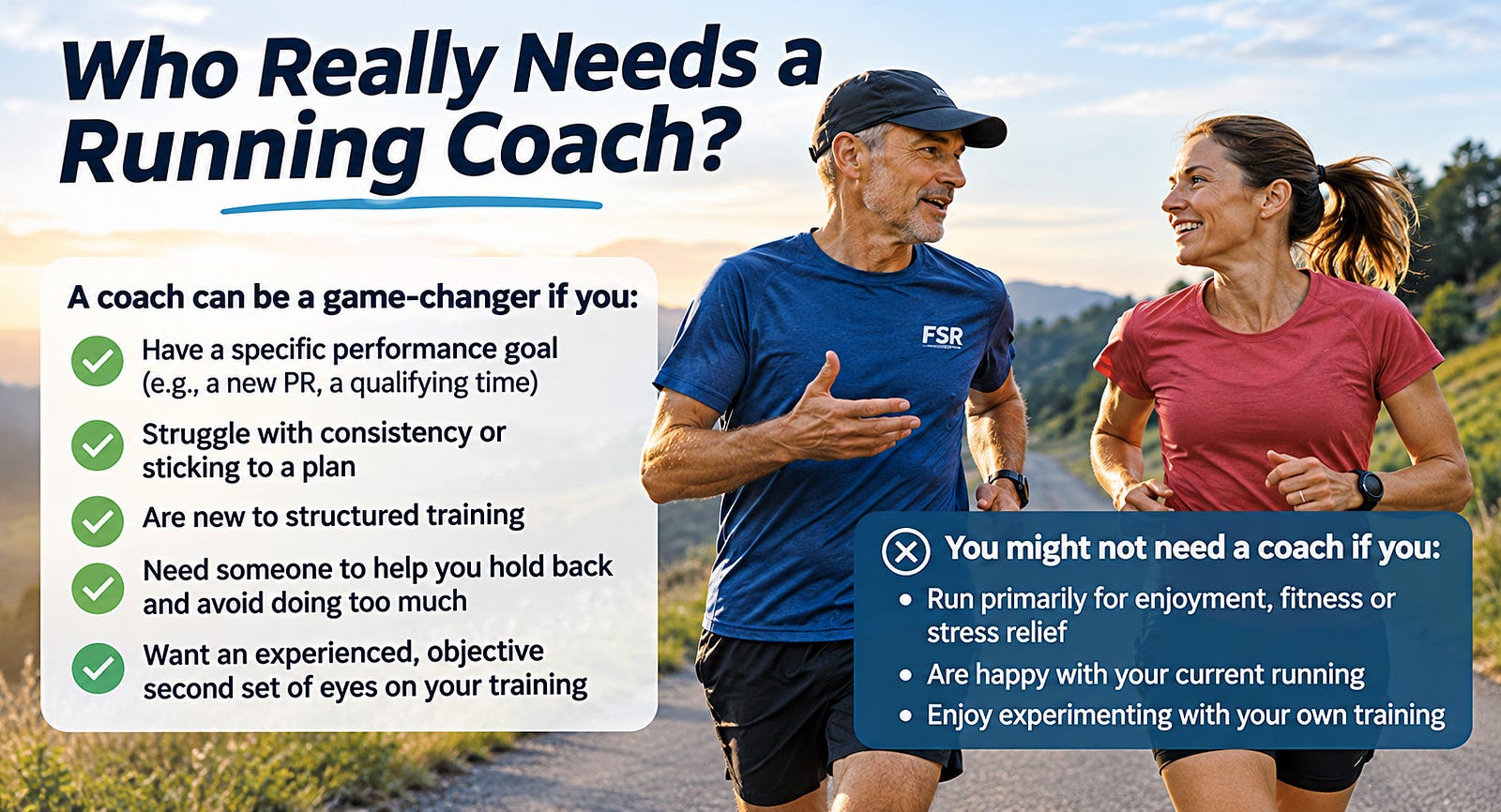
1. Runners Chasing a Specific Goal
Maybe you’re trying to break 20 minutes for 5K, run a sub-40-minute 10K, qualify for Boston, or set a new personal best. It’s no longer just about getting out and running. You need a plan that takes you from where you are today to where you want to be on race day.
That means considering your current fitness, training history, strengths, weaknesses, available time, and how much training you can realistically handle.
A coach can help put those pieces together into a structured program, then make adjustments as your fitness develops.
Of course, you can find plenty of training plans online. Some of them are excellent in the right context.
But those plans don’t know you. They don’t know your strengths, weaknesses, talents, and preferences. They don’t know how you responded to last week’s workout, whether you’re carrying some fatigue, or whether your work schedule has suddenly changed.
As the late George Sheehan famously said, “We are all an experiment of one.”
A good coach doesn’t just write a training plan. They adapt it to the runner.
2. Runners Who Struggle With Consistency
We all know that consistency is one of the biggest factors in long-term running improvement, but knowing that and actually putting it into practice are two different things.
Some runners are constantly changing training plans, skipping workouts when motivation drops, or trying to make up for missed sessions by doing too much. Others have trouble balancing running with work, family, and everything else life throws at them.
A coach can provide structure and accountability.
Not by standing over you and demanding that you complete every workout, but by helping you establish a realistic routine and keeping your training focused on the bigger picture. Sometimes just knowing that someone is following your progress is enough to make a difference.
3. Runners Who Are New to Structured Training
There’s a big difference between being able to run and knowing how to train effectively.
Newer runners often have questions about mileage, workout intensity, recovery, long runs, and how to prepare for races. There’s an enormous amount of running advice available online, and much of it is contradictory.
An experienced coach can help runners cut through that confusion, establish good training habits, and avoid some common mistakes.
The goal shouldn’t be to make runners dependent on their coach forever.
Good coaching should help runners understand their training and become better at making their own decisions.
4. Runners Who Need Someone to Hold Them Back
This might sound a little unusual, but I think it’s one of the most important reasons to have a coach.
Some runners don’t need anyone to motivate them to train harder. They need someone to tell them to slow down.
Competitive runners are often highly motivated people. We like pushing ourselves, chasing faster times, and seeing what we can do.
Those are great qualities, but they can also get us into trouble.
It’s easy to turn an easy run into a moderate effort, push a workout faster than prescribed, or add extra mileage because everything feels good.
The problem is that more training isn’t always better training.
Sometimes the smartest decision is to shorten a workout, take an extra recovery day, or back off the intensity. Those decisions can be surprisingly difficult to make when you’re the one doing the running.
A good coach knows when to push, but just as importantly, when to pull back.
5. Experienced Runners Who Need an Objective Second Opinion
This, to me, is perhaps the biggest benefit of coaching, and it applies just as much to experienced competitive runners as it does to beginners.
You might have been running for 20 or 30 years. You might understand training principles, know your race paces, and have a pretty good idea of what works for you.
All well and good, but here’s the problem:
It’s incredibly difficult to be completely objective about your own training.
When you’re feeling good, you want to do more, perhaps too much.
When you’re struggling, you might question everything. When a race goes badly, you’re tempted to overhaul your program. When you’re chasing an important goal, emotion can easily influence your decisions.
There’s an old saying in the legal profession that a lawyer who represents himself has a fool for a client. The same goes for runners.
Even a knowledgeable runner can benefit from having someone else evaluate their training without the emotional attachment.
A coach can look at the bigger picture, recognize patterns you might be missing, and help you make decisions based on what you actually need rather than what you feel like doing.
Sometimes the most valuable coaching advice isn’t a brilliant new workout or some revolutionary training method. It’s simply having someone say, “You’re doing fine. Stay the course.” Or occasionally, “You’re doing too much. Back off.”
That kind of perspective can be invaluable.
Who Probably Doesn’t Need a Coach?
Now, let’s look at the other side.
If you run primarily for enjoyment, general fitness, stress relief, or simply because you love being outdoors, you may not need a coach at all.
If you’re happy with your running and aren’t particularly concerned about getting faster, there’s no reason you have to turn it into a structured training program.
Likewise, some runners genuinely enjoy experimenting with their own training.
They like researching different methods, putting together programs, trying new workouts, and seeing what happens. For them, figuring things out is part of the enjoyment.
And there are experienced runners who are perfectly capable of managing their own training, especially if they’re achieving their goals and staying healthy.
Coaching isn’t a requirement for being a successful runner.
It’s a tool that can be useful when you want guidance, accountability, perspective, or help achieving something specific.
The Bottom Line
You don’t need a coach to enjoy running, stay fit, or even run some very good race times.
But if you’re serious about improving, have a specific goal in mind, or find yourself struggling with consistency, progression, or knowing when to push and when to back off, having an experienced coach can make a difference.
For me, the biggest value isn’t necessarily the training plan itself.
It’s having someone who can look at your running objectively, understand your goals, and help you make better decisions along the way.
Because sometimes the hardest runner to coach is yourself.
Wondering Whether Coaching Could Help Your Running?
I offer a free 30-minute training review where we can talk about your current training, your goals, and any challenges you’re facing.
There’s no obligation to sign up for coaching. It’s simply an opportunity to get another perspective on your training and see whether working with a coach makes sense for you.


Discussion about this post