7 Habits of Highly Effective Runners

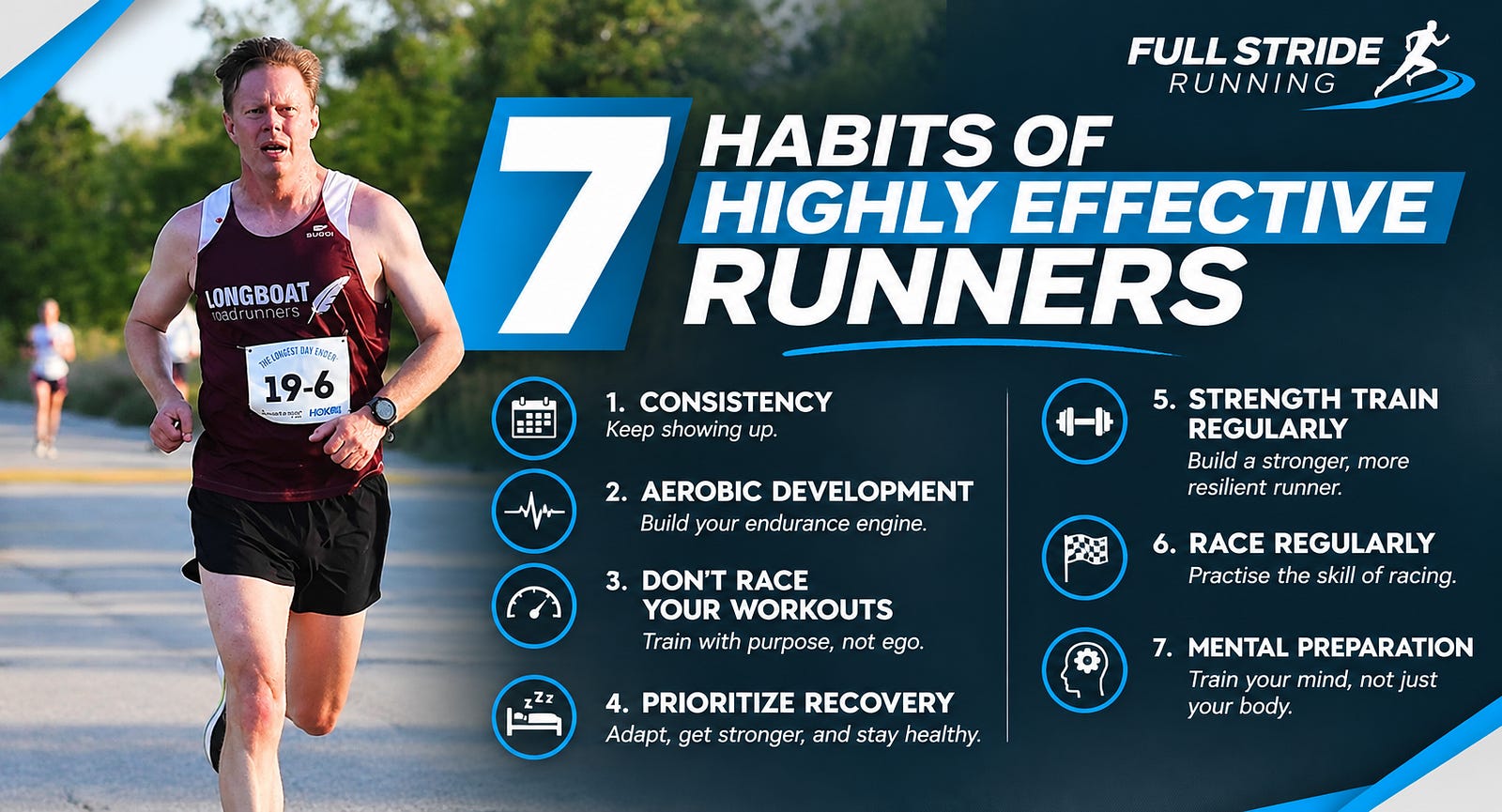
Every runner wants to improve. We look for better workouts, faster shoes, new training methods, and ways to squeeze a little more performance out of ourselves.
But after decades of running and now coaching, I’ve come to believe that the biggest improvements rarely come from discovering some revolutionary training secret.
They come from developing good habits.
The most effective runners aren’t necessarily the most talented or the hardest working. They’re the ones who consistently do the things that matter, week after week and year after year.
Here are seven habits I’ve observed in runners who get the most out of their training.
Habit 1: They Value Consistency Over Heroic Workouts
The best training program is the one you can sustain.
Effective runners understand that fitness is built through accumulated training, not occasional extraordinary efforts. They don’t chase mileage for its own sake, cram missed sessions into the weekend, or try to make up for lost training.
They recognize that one spectacular workout means very little compared with months of consistent, manageable training.
As the new one mile World Record holder Josh Kerr says, “I don't do crazy workouts or crazy mileage. I just don't miss days. Consistency is my biggest weapon.”
Key takeaway: A good week repeated 20 times beats one incredible week followed by injury or exhaustion.
Habit 2: They Build Their Aerobic Engine
Aerobic development is the foundation of distance running.
Successful runners understand that most of their training should develop aerobic fitness. They spend plenty of time running at comfortable, sustainable intensities, building the endurance that supports everything else.
They also understand that aerobic development takes time. It’s a long-term investment, not something you accomplish in a few weeks.
Of course, interval workouts, threshold sessions, hills and strides are also important, but volume of easy to steady running is the foundation on which you build everything else.
Key takeaway: Your aerobic engine determines how much of your speed you can sustain.
Habit 3: They Don’t Race Their Workouts
Training is preparation for racing, not a competition in itself.
Effective runners know the purpose of each workout and execute it accordingly.
A threshold workout should develop threshold fitness. An interval session should target VO2 max. An easy run should be genuinely easy.
Resist the temptation to turn every session into a personal best attempt. Completing a workout faster than prescribed doesn’t necessarily make it more effective. It simply adds fatigue without providing additional benefits.
Eluid Kipchoge has said in interviews that he typically trains at about 80% effort on harder days and 50% on easier days. The point isn't the exact percentages, but his discipline in controlling effort.
Key takeaway: The goal isn’t to win the workout. It’s to benefit from it.
Ready to Take Your Running to the Next Level?
Knowing what to do is one thing. Putting it all together into a training plan that works for you is another.
At Full Stride Running, I offer personalized 1:1 coaching to help runners train smarter, improve performance, and stay healthy for the long run.
Whether you’re chasing a new PB or simply want to get more out of your running, I’d love to help.
Habit 4: They Prioritize Recovery
Training provides the stimulus. Recovery allows adaptation.
Effective runners understand that recovery is part of the training process, not time wasted. They prioritize sleep, nutrition, appropriate rest days, and sensible training progression.
They also learn to recognize when their body needs additional recovery.
Masters runners, in particular, need to pay special attention to recovery. Getting older doesn’t mean you can’t train hard, it just means you may need more recovery between sessions.
As I’ve gotten older, I’ve reduced from 3 quality sessions (interval, tempo and long run) per week to 2 (just an interval session and a long run with maybe some faster running at the end) . I was shocked to find I actually improved with fewer hard days.
The workout provides the stimulus. Recovery allows the adaptation.
Key takeaway: You don’t get fitter simply by training harder. You get fitter by recovering and adapting to training.
Habit 5: They Make Strength Training a Regular Habit
Strong runners need more than cardiovascular fitness.
Effective runners recognize that running places substantial demands on muscles, tendons, bones, and connective tissues. They incorporate regular strength training to improve their physical capacity and support running performance.
Greater strength means better running economy, which means you run faster for the same fitness level.
One or two well-planned strength sessions per week are enough for most runners. Keep it simple, target the major muscle groups and remember the goal is running faster, not training to win a bodybuilding competition.
You don’t necessarily need to go to the gym and lift heavy weights, Meb Keflezhigi, winner of the 2014 Boston Marathon focused mainly on core work and body weight exercises.
Key takeaway: Strength training supports the body that does all the running.
Habit 6: They Race Regularly
Racing is a skill, and skills improve with practice.
Effective runners understand that racing develops abilities that are difficult to replicate in training. Pacing, managing discomfort, controlling nerves, making tactical decisions, and responding to competition all improve through experience.
Regular racing also provides valuable feedback about fitness and training effectiveness. Bill Rodgers used to run 25-30 races per year when he was in the midst of winning the Boston and New York City marathons 4 times each. But many of these races were low key and almost treated as hard tempo runs rather than all out races.
Racing regularly doesn’t mean racing every weekend or running every race at maximum effort. Frequency should suit the runner’s experience, goals, and recovery capacity.
Key takeaway: You can train to become fit, but you also need to practise becoming a good racer.
Habit 7: They Prepare Their Minds as Well as Their Bodies
Physical preparation gets you to the starting line. Mental preparation helps you perform.
Effective runners understand that racing involves more than physical fitness. They develop routines to manage pre-race anxiety, visualize successful performances, and prepare for difficult moments.
They focus on what they can control: their preparation, pacing, effort, and response to adversity.
Kipchoge is known for treating mental preparation as an essential part of performance, not something to think about only on race day.
His philosophy emphasizes developing the mental discipline to execute a plan, manage discomfort and stay focused on the task rather than the outcome.
One of the best ways to do this is to set A, B and C goals. A being the best you can imagine running, B is a solid but unspectacular race, and C is the minimum you want to walk away with after the race.
Key takeaway: Confidence comes from preparation, and mental skills improve through practice.
Small Habits, Big Results
None of these habits are complicated. There’s no secret workout, magic training formula, or shortcut to becoming a better runner.
Runners who improve year after year are generally the ones who do the fundamentals well and continue doing them long enough to see the benefits.
And perhaps the most important habit of all is learning to enjoy the process.
Because when you enjoy what you’re doing, consistency becomes much easier.
Introducing the Full Stride Running Club

I’ve been working on something over the past few months that I’m excited to finally share.


Discussion about this post