


A good marathon training plan isn’t just a collection of workouts.
It’s a rhythm.
One of the biggest mistakes runners make is looking at individual workouts in isolation. They worry about which interval session to run, how fast their tempo should be, or whether their long run should be 28 km or 30 km.
Those things matter, but the way the entire week fits together matters even more.
The goal is to arrange your training so that you get enough stimulus to improve while still having enough recovery to absorb that training.
For most runners, that means something surprisingly simple:
One quality workout. One long run. A few small doses of faster running. Lots of easy running. And one complete rest day.
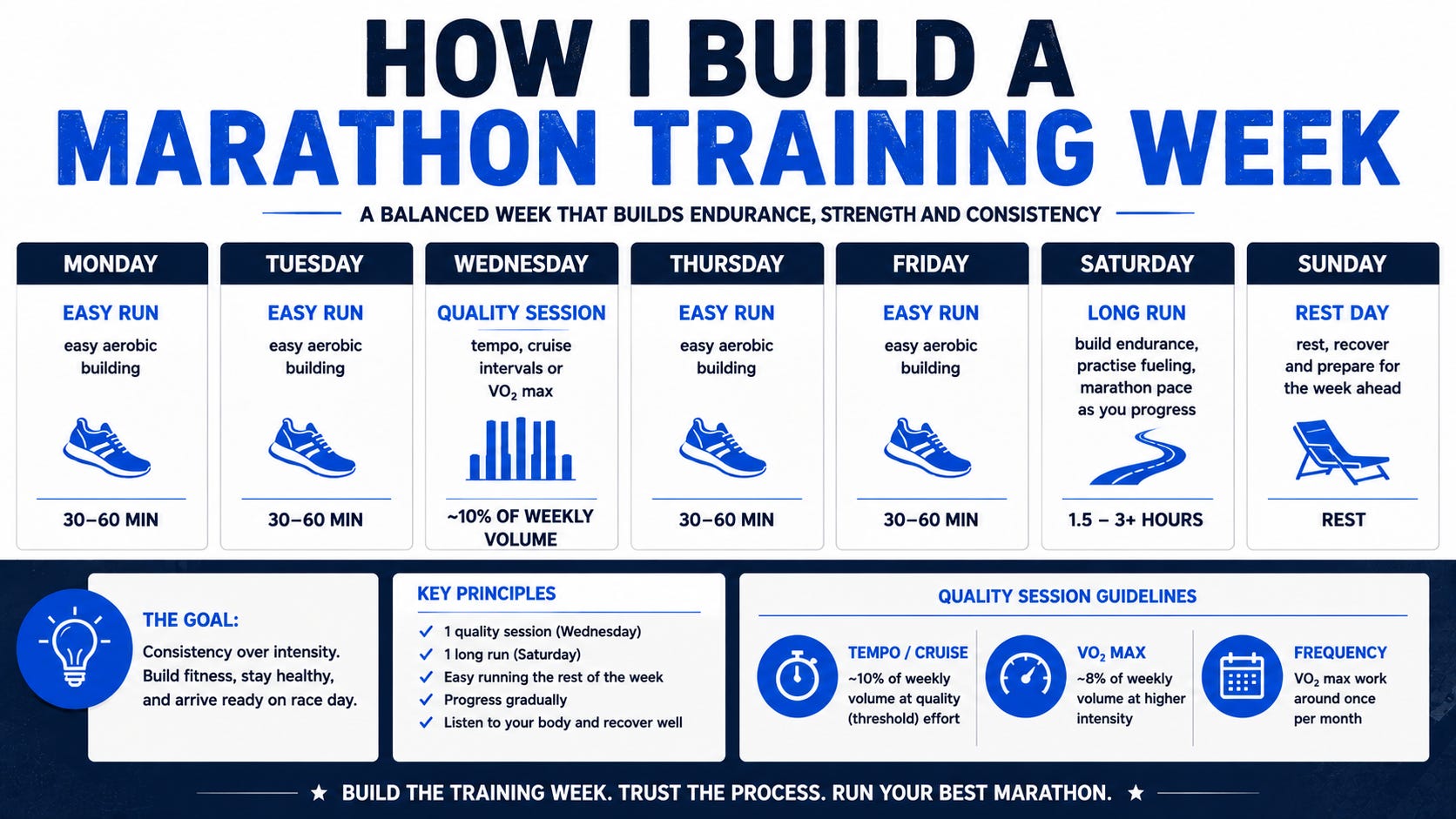
My Preferred Marathon Training Week
Here’s the basic structure I like:
Monday: Easy run
Tuesday: Easy run + 4–6 strides
Wednesday: Quality workout
Thursday: Easy run
Friday: Easy run + 6–8 strides OR short hill reps
Saturday: Long run
Sunday: Rest
The exact mileage will vary considerably depending on the runner. What matters here is the structure.
Let’s look at why it’s organized this way.
Monday: Easy Running
Monday is deliberately easy.
You’re starting the training week with relaxed aerobic running. There is no need to force the pace or try to make the run more productive.
Remember that easy running isn’t filler. It’s where much of your aerobic development takes place.
Run comfortably and finish feeling like you could have done more.
Tuesday: Easy + Strides
Tuesday is another easy aerobic day, but we’ll finish with 4–6 strides.
Strides are short, controlled accelerations that allow you to run faster without creating the fatigue of a hard workout.
Think smooth and relaxed rather than all-out.
They’re a simple way to maintain running economy, coordination and speed while you’re accumulating a lot of relatively slow marathon training.
They’re also useful preparation for Wednesday’s workout. You’re reminding your legs what faster running feels like without tiring yourself out.
Wednesday: Quality Day
Wednesday is normally the primary quality session of the week.
For marathon runners, this will often be something like:
A tempo run
Cruise intervals
Marathon-pace running
Occasionally, faster intervals such as VO2 max sessions
The exact workout will depend on where you are in the training cycle and what we’re trying to accomplish.
But there’s an important principle here:
Every workout must have a purpose.
We aren’t running hard on Wednesday simply because the schedule says it’s “workout day.”
There should be a specific physiological or performance reason for the session, not just ‘run the session as hard as you can’.
The goal is to create a specific training stimulus to produce adaptation without creating so much fatigue that it compromises the rest of your week.
Thursday: Easy Means Easy
Thursday is recovery through easy aerobic running.
This is one of the days where runners sometimes get themselves into trouble.
Wednesday went well. You’re feeling fit. So Thursday’s easy run gradually becomes a moderate run.
Don’t do it.
The purpose of Thursday is to recover from Wednesday while continuing to build aerobic volume. This run needs to be easy, likely the easiest day of your entire week.
You should be setting yourself up for the training ahead rather than proving your fitness on an easy day.
Friday: Easy + Speed Maintenance
Friday is another easy run, but we’ll often finish with one of two options:
6–8 strides, or
Short hill repetitions of approximately 10 seconds with full recovery.
*These are not meant to become another hard workout!!! *
The hill reps in particular should be short, controlled and powerful, with plenty of recovery between repetitions. We’re developing recruitment, coordination, strength and running economy without producing significant fatigue.
You should finish Friday feeling good.
Remember: the long run is tomorrow.
Saturday: The Long Run
Saturday is our second major training stimulus of the week.
Early in the program, the long run may simply be comfortable aerobic running.
As you become fitter and move deeper into marathon preparation, some long runs may become more specific and include sections at a faster pace.
But not every long run needs to be hard.
There’s enormous value in simply spending time on your feet and gradually developing the endurance required for the marathon.
Wednesday and Saturday therefore become the two anchors of the training week:
Wednesday develops quality.
Saturday develops endurance.
Most of the remaining training supports those two sessions.
Sunday: Actually Rest
A lot of runners prefer doing their long run on Sunday.
There’s absolutely nothing wrong with that.
If Sunday works better for your schedule, move the long run to Sunday and organize your week accordingly.
Personally, however, I like Saturday long runs followed by a Sunday rest day.
There’s a practical reason for this that has nothing to do with physiology.
Sunday can actually be a rest day.
For someone working Monday through Friday, taking a weekday “rest day” doesn’t necessarily mean resting.
You work all day. You commute. You pick up groceries. You run errands. You make dinner. You deal with everything else happening in your life.
You may not have run, but it wasn’t exactly relaxing.
Sunday is different.
After Saturday’s long run, you can sleep in a little, have a relaxed breakfast, spend time with your family, read, watch a movie, or simply enjoy having nowhere you need to run.
The key lesson here is that even though it’s a major goal that require significant focus, marathon training needs to fit into your life rather than consume it.
Want some help building your own marathon training week?
I offer personalized one-on-one running coaching through Team RunRun. Your training is built around your experience, goals, schedule and life, with an emphasis on sustainable training, purposeful workouts and long-term consistency.
If you’d like someone in your corner to take the guesswork out of your training, check out my coaching page here.
Also, paid subscribers to Full Stride Running are eligible for a free coaching call to discuss your current training in detail and provide recommendations you can implement on your own.
Notice What’s Missing
Look back at the schedule.
There’s only one traditional quality workout during the week.
You don’t need to (and shouldn’t) try to cram three hard workouts into seven days to become a better marathon runner.
The long run itself is a significant training stimulus, particularly as it becomes longer or more marathon-specific later in the program.
The strides and short hills provide small doses of faster running without creating much additional fatigue.
Everything else builds aerobic fitness and supports recovery.
That gives us a week containing:
1 quality workout + 1 long run + 2 small doses of speed + 3 easy runs + 1 rest day.
Simple.
But over months of consistent training, extremely effective.
The Week Should Have a Rhythm
One of the themes you’ll see throughout Full Stride Running is that good training doesn’t need to be complicated.
You don’t improve because you managed to squeeze the maximum possible amount of stress into seven days.
You improve because you apply an appropriate training stimulus, recover from it, adapt, and then repeat the process.
Wednesday gives us quality.
Saturday gives us endurance.
The easy days allow us to accumulate aerobic volume.
The strides and hills keep some speed and athleticism in the program.
And Sunday gives us genuine recovery.
Train. Recover. Adapt. Repeat.


